SWP Calculator — Systematic Withdrawal Plan Calculator | AliGreat.com
Free SWP Calculator for India — find out how long your corpus will last with a fixed monthly withdrawal, and how much you’ll withdraw in total.
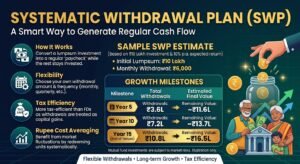
A Systematic Withdrawal Plan is essentially a SIP in reverse — instead of investing a fixed amount every month, you withdraw one, typically from a mutual fund corpus built over years of saving and investing. The question every retiree, or anyone drawing an income from an investment corpus, eventually asks is: how long will this money actually last at the withdrawal rate I want? The SWP Calculator on AliGreat.com answers exactly that, month by month.
What does the SWP Calculator do?
Enter your starting corpus, the fixed monthly amount you plan to withdraw, the expected annual return on the remaining balance, and the withdrawal period you want to plan for. The calculator shows how much corpus remains at the end of that period, the total amount withdrawn over the full duration, and — if the corpus is projected to run out early — exactly which month that depletion happens.
The formula behind it
Each month, the SWP calculation follows a simple but important compounding-then-withdrawing sequence:
Balance = Balance × (1 + r) − Withdrawal
repeated for every month in the period, where r is the monthly rate of return. This is meaningfully different from a straightforward compound interest formula because money is being removed from the corpus at the same time growth is being applied to it — which is exactly why a corpus can deplete far faster than simple intuition suggests once monthly withdrawals start to exceed what the remaining balance’s returns can replace.
A worked example
Suppose you start with a corpus of ₹50,00,000, withdraw ₹25,000 every month, expect an 8% annual return on the balance, and want to plan for a 20-year withdrawal period.
Running this through the month-by-month formula shows the corpus survives the full 20 years, ending with a remaining balance of roughly ₹68,00,000 — the corpus actually grows despite ongoing withdrawals, because the 8% return on a large remaining balance consistently outpaces the ₹25,000 monthly draw. Total withdrawn over the 20 years comes to ₹60,00,000.
Now compare this to the same corpus with a higher monthly withdrawal of ₹45,000 instead of ₹25,000: the corpus depletes entirely around month 210 (roughly 17.5 years in) rather than lasting the full 20-year target — a stark illustration of how sensitive an SWP’s sustainability is to the specific withdrawal amount chosen relative to the corpus size and return assumption.
Why sequence-of-returns risk matters more than the average return
An SWP carries a risk that a simple average-return calculation doesn’t fully capture: if markets fall sharply in the early years of withdrawal, the corpus takes a compounding double hit — it loses value from the market fall, and you’re simultaneously still withdrawing the same fixed amount from an already-shrinking base. This is called sequence-of-returns risk, and it’s genuinely one of the most under-appreciated risks in retirement income planning. Two SWPs with the exact same average annual return over 20 years can produce dramatically different outcomes purely depending on whether the bad years happened early (more damaging) or late (less damaging) in the withdrawal period.
Because this calculator uses a single, constant assumed return rate rather than modelling year-to-year market volatility, it should be treated as a simplified planning tool rather than a guarantee. Running the calculator at a somewhat lower assumed return than your optimistic estimate — say, 2-3 percentage points below your long-term expectation — gives a more conservative, and generally more realistic, picture of how long your corpus is likely to actually last through real market ups and downs.
Choosing a sustainable withdrawal rate
A common rule of thumb in retirement planning circles is to withdraw no more annually than what your investments can reasonably be expected to earn after accounting for inflation, so the corpus itself isn’t shrinking in real, inflation-adjusted terms over time. For a corpus expected to return 8-9% annually before inflation, an annual withdrawal rate of around 4-5% is often cited as a broadly sustainable starting point, though this varies with individual circumstances, market conditions, and how long the withdrawal period needs to last.
Use the calculator to test a few different monthly withdrawal amounts against the same corpus and return assumption — the difference between a corpus that comfortably lasts 25+ years and one that depletes in just 12-15 years is often a surprisingly small percentage change in the monthly withdrawal figure, which is exactly the kind of sensitivity this tool is built to reveal quickly.
SWP vs simply keeping money in a savings account
Keeping retirement savings invested in a mutual fund and running an SWP, rather than parking the corpus in a savings account and withdrawing manually, means the remaining balance keeps growing (or at least has the potential to) even as you continue drawing from it — which is precisely why SWPs are popular among retirees who want their corpus to outlast what a fixed, low-interest savings account equivalent would achieve. A savings account typically earns 3-4% interest, well below what a diversified mutual fund portfolio has historically delivered, meaning an SWP from a savings account alone would deplete considerably faster than an equivalent SWP from an invested corpus.
Tax efficiency of an SWP
One often-overlooked advantage of an SWP over, say, FD interest income, is tax efficiency. Each SWP instalment consists partly of your original capital and partly of gains, and only the gains portion is taxed as capital gains (at rates depending on holding period and fund type) — unlike FD interest, which is fully taxable as regular income on the entire interest amount. For retirees in higher tax brackets, this structural difference can make an SWP from a mutual fund meaningfully more tax-efficient than drawing an equivalent income from FD interest, though the exact tax treatment depends on current capital gains rules and the specific fund category.
When an SWP makes more sense than an annuity
Compared to an NPS annuity (covered in AliGreat.com’s NPS Calculator), an SWP offers considerably more flexibility — you can adjust or pause your withdrawal amount at any time, and any remaining corpus is fully inheritable by your nominees. An annuity, by contrast, offers a guaranteed income for life regardless of how long you live or how markets perform, at the cost of flexibility and, in many cases, no remaining value passed on after the pension holder’s death. Many retirees use a combination: a portion in a guaranteed annuity for baseline security, and a portion in an SWP for flexibility and potential growth.
Who should use this calculator
Anyone approaching retirement and planning how to draw a regular income from an accumulated mutual fund corpus, or evaluating whether a given corpus size genuinely supports their desired monthly withdrawal over their expected retirement horizon, will find this calculator essential before committing to a specific withdrawal plan. It’s also useful for people who’ve received a large one-time payout — a retirement gratuity, a property sale, an inheritance — and want to convert it into a sustainable monthly income stream rather than a lump sum sitting idle.
Frequently asked questions
Can my SWP corpus actually grow even while I’m withdrawing from it? Yes — if your assumed rate of return exceeds your withdrawal rate (as a percentage of the corpus), the balance can grow over time despite ongoing monthly withdrawals, as shown in the first worked example above.
What happens if my corpus runs out before my planned withdrawal period ends? The calculator flags the specific month depletion is projected to occur, so you can adjust your withdrawal amount, extend your assumed return, or reduce your planned withdrawal period accordingly before committing to that withdrawal rate in real life.
Is SWP income guaranteed like an annuity? No — unlike an annuity, SWP income depends entirely on your corpus’s actual market performance, which can vary from the assumed return rate used in this calculator, especially in the short term.
Is SWP income taxed differently from FD interest? Yes — only the capital gains portion of each SWP withdrawal is taxed, not the entire withdrawal amount, making it generally more tax-efficient than FD interest income of the same size, though exact rates depend on current tax rules and fund type.
Try it now
Open the SWP Calculator on AliGreat.com, enter your corpus and withdrawal amount, and see exactly how long your money is projected to last — free, instant, and formula-transparent.