Loan Amortization Calculator — Year-by-Year Loan Payoff Schedule | AliGreat.com
Free Loan Amortization Calculator for India — see the exact year-by-year split of principal and interest for any loan, plus your remaining balance.
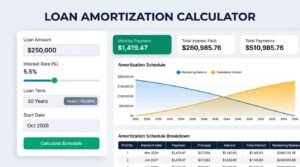
Every loan EMI hides a shifting story underneath its fixed monthly number: how much of it goes to interest versus how much reduces your actual debt changes every single month of the loan, even though the EMI figure itself never moves. The Loan Amortization Calculator on AliGreat.com unpacks that story into a clear, year-by-year table, so you can see exactly where your money is going at any point across the loan’s life, not just what leaves your account each month.
What does the Loan Amortization Calculator do?
Enter your loan amount, interest rate, and tenure. Alongside the standard EMI, total interest, and total payable figures, this calculator generates a full year-by-year table showing principal paid, interest paid, and the remaining loan balance for every year of the tenure — turning an abstract single EMI number into a concrete, visible payoff timeline you can actually inspect year by year.
The formula behind it
Each month, interest is calculated on the outstanding balance from the previous month, and the remainder of the fixed EMI reduces the principal:
Interest (this month) = Outstanding balance × Monthly rate Principal (this month) = EMI − Interest
The outstanding balance then shrinks by that month’s principal portion, and the entire cycle repeats for every month of the loan — the calculator runs this calculation month-by-month internally and rolls the results up into yearly totals for easier reading and comparison.
A worked example
Take a loan of ₹30,00,000 at 9% interest for 15 years (180 months). The monthly EMI works out to roughly ₹30,428. Looking at the year-by-year table this calculator generates:
- Year 1: approximately ₹2,66,190 in interest and ₹98,946 in principal paid — interest makes up nearly 73% of that year’s total payments
- Year 8 (roughly midway): the split has shifted meaningfully, with principal now making up a noticeably larger share of each year’s payments than interest
- Year 15 (final year): almost the entire year’s payments go toward principal, with interest reduced to a small fraction, since the outstanding balance by then is minimal
This progressive shift — from interest-dominated payments early on to principal-dominated payments later — is the single most important pattern the amortization table reveals, and it’s completely invisible if you only ever look at the flat, unchanging EMI figure.
Why the amortization table matters more than the EMI figure alone
Looking only at your EMI tells you what leaves your account every month, but it completely hides how slowly your actual debt shrinks in the early years of a long-tenure loan. In the example above, after a full year of consistent ₹30,428 monthly payments (₹3,65,136 total for the year), the outstanding loan balance has fallen by less than ₹1,00,000 — meaning the vast majority of that first year’s substantial payments went purely toward the bank’s interest income rather than actually reducing the debt. This can be genuinely surprising, even unsettling, for borrowers who assume a year of “on-time EMI payments” automatically translates into a proportional reduction in what they owe.
How this table changes prepayment decisions
Because interest in any amortising loan is front-loaded — highest when the outstanding balance is highest, which is right at the start — a lump-sum prepayment made early in the loan saves dramatically more total interest than the identical rupee amount prepaid later, since you’re cutting principal while the bank is still charging interest on the largest possible remaining balance. This is exactly the insight the amortization table is built to make visible, and it’s also why AliGreat.com’s Prepayment Calculator exists as a natural next step from this one — once you can see from the amortization table just how much interest is being paid in the early years, the case for an early prepayment becomes concrete rather than abstract.
Finding your loan’s “crossover point”
Look at where, in the year-by-year table, the principal-paid portion of your annual payments first exceeds the interest-paid portion — this is sometimes informally called the loan’s crossover point. For many long-tenure home loans (20-30 years) at typical current rates, this crossover doesn’t happen until somewhere around the halfway mark of the tenure, meaning for the first several years, more than half of every payment is effectively “rent” paid to the bank for the use of its money, rather than a reduction in what’s owed. Knowing where this crossover point sits for your specific loan is genuinely useful information when deciding whether an early prepayment, refinancing to a shorter tenure, or continuing the original schedule makes the most financial sense for your situation.
Amortization and loan refinancing decisions
If you’re considering refinancing an existing loan to a lower interest rate (a balance transfer), the amortization table helps clarify exactly how much of your remaining tenure is still interest-heavy versus principal-heavy. Refinancing a loan that’s still early in its amortization schedule (where interest dominates) captures more benefit from a lower rate than refinancing a loan that’s already well past its crossover point, where the remaining interest savings potential is naturally smaller since less interest remains to be saved on a mostly-repaid balance.
Amortization schedules for different loan types
While this calculator’s underlying formula applies universally to any reducing-balance EMI loan — home, personal, car, or education — the shape of the resulting amortization curve differs meaningfully by tenure length. A short-tenure loan (like a 3-5 year personal loan) reaches its crossover point relatively quickly, since there simply isn’t much time for interest to compound heavily against a large balance. A long-tenure loan (like a 20-25 year home loan) has a much more prolonged interest-heavy phase, precisely because the extended timeline gives interest far more time to accumulate against a still-substantial outstanding balance in the early-to-middle years.
Reading the table for tax planning purposes
For self-occupied home loans under the old tax regime, only the interest component (up to the Section 24(b) limit) and principal component (within the 80C limit) are separately deductible — the amortization table’s year-by-year interest and principal breakdown is directly useful here, since it lets you see, well in advance, roughly how much interest deduction you’re likely to be eligible for in any given future year of the loan, which tends to decline gradually as the loan matures and the interest portion shrinks.
Who should use this calculator
Anyone who wants to understand exactly how their loan balance will fall over time — not just what the monthly EMI is — should use this calculator, particularly before deciding on a prepayment strategy, comparing the true cost of two different loan tenures, or estimating future years’ interest deduction for tax planning purposes. It’s also a genuinely useful tool simply for understanding, in concrete terms, exactly where a large loan payment is actually going each month, rather than treating the EMI as an opaque, unchanging monthly expense.
Frequently asked questions
Why does my outstanding balance seem to fall so slowly in the first few years? Interest is calculated on the outstanding balance, which is highest at the start of the loan, so a larger share of each early EMI goes toward interest rather than reducing the principal — this naturally corrects itself as the balance falls over time.
Does the amortization schedule change if I make an extra payment mid-loan? Yes — an extra payment reduces your outstanding principal immediately, which reduces all future interest calculations for the remainder of the loan. AliGreat.com’s Prepayment Calculator is built specifically to model this scenario.
Is the amortization schedule the same for every type of loan? The underlying month-by-month calculation is the same for any standard reducing-balance EMI loan, but the specific shape of the interest-versus-principal curve depends on the loan’s rate and tenure — longer tenures produce a more prolonged interest-heavy phase.
Can I use this table to estimate my home loan tax deduction for future years? Yes — the year-by-year interest figure shown gives a reasonable estimate of your likely Section 24(b) deductible interest for that future year, assuming your rate and payment schedule remain unchanged.
Try it now
Open the Loan Amortization Calculator on AliGreat.com, enter your loan details, and see the full year-by-year breakdown — free, instant, and completely transparent.