Atal Pension Yojana Calculator — APY Contribution & Pension Calculator | AliGreat.com
Free Atal Pension Yojana Calculator for India — find your fixed monthly APY contribution and the guaranteed pension it buys at age 60.
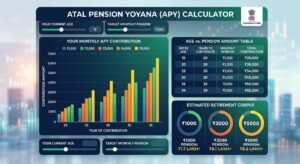
The Atal Pension Yojana is one of the few retirement products in India where the government itself guarantees your monthly pension amount, regardless of how markets perform — a rare feature that makes it particularly attractive for workers in the unorganised sector who don’t have access to employer-sponsored retirement benefits like EPF. The one thing that confuses most people before joining is simple: how much will I actually need to contribute every month to get the pension I want? The Atal Pension Yojana Calculator on AliGreat.com answers that instantly.
What does the APY Calculator do?
Enter your current age (between 18 and 40, the only window during which you can join APY) and your desired monthly pension at age 60 — ₹1,000, ₹2,000, ₹3,000, ₹4,000, or ₹5,000. The calculator instantly shows your fixed monthly contribution, the number of years you’ll be contributing, your total contribution over that period, and the government-guaranteed corpus that backs your chosen pension slab.
The formula behind it — and why it’s a lookup table, not a simple equation
Unlike most calculators on this site, APY contributions aren’t derived from a simple compounding formula you can write in one line. The Pension Fund Regulatory and Development Authority (PFRDA) has worked out, through actuarial calculations, exactly what monthly contribution at each entry age accumulates — with government-backed investment growth — into the corpus needed to fund each pension slab for life from age 60. This calculator uses PFRDA’s official published age-wise contribution table to look up your exact instalment, rather than approximating it with a formula.
A worked example
Suppose you’re 25 years old and want a guaranteed monthly pension of ₹3,000 starting at age 60.
- Monthly contribution (from the official table): ₹226
- Years of contribution: 60 − 25 = 35 years
- Total you’ll pay in: ₹226 × 12 × 35 ≈ ₹94,920
- Government-guaranteed corpus at 60 for the ₹3,000 slab: ₹5,10,000
Compare this to joining at age 35 instead of 25, for the same ₹3,000 pension: the monthly contribution jumps to ₹543, and total contribution over the shorter 25-year window comes to roughly ₹1,62,900 — considerably more in total, despite fewer years of paying in, purely because there’s less time for the government’s guaranteed growth to do the work. This single comparison is the clearest illustration of why joining APY as early as possible within the 18-40 window meaningfully reduces your lifetime contribution cost for the same eventual pension.
Why entry age matters so much
The fundamental mechanism behind APY is identical to any long-term compounding investment: money contributed earlier has more years to grow before you need to draw on it. A 20-year-old joining for a ₹5,000 pension pays a monthly contribution of roughly ₹248, while someone joining at 39 for the identical ₹5,000 pension pays ₹1,318 a month — more than five times as much, for exactly the same eventual guaranteed pension. This is precisely why APY, despite being open to anyone up to age 40, is most commonly recommended to be joined as early as possible, ideally in your early-to-mid twenties.
Who is APY actually designed for?
While technically open to any Indian citizen aged 18-40 with a bank or post office savings account, APY was specifically designed with the unorganised sector in mind — workers like small shop owners, daily wage labourers, domestic workers, drivers, and others who don’t have access to formal employer-provided retirement benefits like EPF or a company pension. For salaried employees already covered by EPF or NPS, APY can still serve as a supplementary, guaranteed-pension layer, though the relatively modest maximum pension slab (₹5,000/month) means it’s rarely a standalone retirement solution for higher earners.
The government co-contribution (for early enrollees)
In the scheme’s original design, the government offered to co-contribute 50% of the subscriber’s contribution (up to ₹1,000 per year) for individuals who joined between specific launch dates and who weren’t covered by any statutory social security scheme or didn’t pay income tax. This co-contribution benefit was tied to specific enrollment windows and eligibility conditions that have evolved since the scheme’s 2015 launch — if you’re exploring APY today, check with your bank or the official APY/NPS Trust website for whatever co-contribution terms currently apply, since this calculator’s contribution figures reflect the subscriber’s own payment, not any government top-up.
What happens to your contribution if you exit early or pass away
If a subscriber passes away before age 60, the accumulated pension wealth (not just the guaranteed pension) is paid to the spouse, who can choose to continue contributing and receive the same pension, or receive the accumulated corpus as a lump sum. If both subscriber and spouse pass away before 60, the accumulated corpus is paid to the nominee. If a subscriber chooses to exit the scheme voluntarily before age 60 (other than for specified exceptional circumstances), they generally only receive their own contributions plus the actual investment returns earned — not the government-guaranteed pension amount, which applies specifically at the full vesting age of 60. This distinction — guaranteed pension at 60 versus accumulated-returns-only on early exit — is an important detail to understand before treating APY as a flexible, anytime-withdrawable savings account.
APY vs NPS — which should you choose?
NPS (covered in AliGreat.com’s dedicated NPS Calculator) offers market-linked growth with potentially higher returns, an additional ₹50,000 tax deduction under Section 80CCD(1B), and no upper cap on the pension amount you can build toward — but it carries market risk and a more complex annuity-purchase structure at retirement. APY offers a government-guaranteed, fixed pension with none of NPS’s market risk, but is capped at a maximum of ₹5,000 monthly pension and generally suits those prioritising absolute certainty over growth potential, or those in the unorganised sector without easy access to NPS’s more involved onboarding process. Many financial planners view APY less as a competitor to NPS and more as a guaranteed baseline — particularly valuable for lower-income households where even a small guaranteed pension meaningfully improves retirement security.
Tax treatment of APY contributions
APY contributions are eligible for a tax deduction under Section 80CCD, within the same overall framework as NPS contributions — subject to the combined 80C/80CCD limits under the old tax regime. The pension received after age 60 is taxable as regular income in the year received, similar to how most pension income is treated under Indian tax law.
A practical note on auto-debit and missed contributions
APY contributions are collected via auto-debit from your linked bank account, typically monthly, quarterly, or half-yearly, depending on your preference. Missing contributions attracts a small penalty fee (varying by contribution amount), and prolonged non-payment can lead to account freezing, deactivation, or eventual closure with return of the accumulated corpus. Since this calculator assumes uninterrupted contribution from your current age until 60, treat any real-world shortfall in contribution continuity as a factor that could reduce your actual pension below the stated guaranteed figure — maintaining a consistent auto-debit arrangement is important for the guarantee to apply as calculated.
Who should use this calculator
Anyone aged 18-40 considering APY — particularly those in the unorganised sector without access to employer-provided retirement benefits — will find this calculator useful for understanding exactly what monthly commitment is required for their desired pension level, and how much that commitment changes with entry age. It’s also a useful comparison tool for those weighing APY against voluntarily contributing a similar amount to NPS or a PPF account instead.
Frequently asked questions
Can I join APY after age 40? No — APY enrollment is restricted to individuals between 18 and 40 years of age; once you cross 40, you’re no longer eligible to newly join the scheme.
Is the APY pension amount truly guaranteed regardless of investment performance? Yes — the Government of India guarantees the minimum pension amount for the chosen slab, backstopping any shortfall between actual investment returns and what’s needed to fund the promised pension, which is a distinguishing feature compared to market-linked products like NPS.
What happens to my corpus if I die after age 60, while receiving the pension? Your spouse continues receiving the same guaranteed pension for their lifetime; after both subscriber and spouse have passed away, the accumulated pension wealth is paid to the nominee.
Can I increase my pension slab after joining APY? Yes, subscribers are generally permitted to upgrade or downgrade their chosen pension amount once a year, typically during a specified window, with the monthly contribution adjusted accordingly based on your current age at the time of the change.
Try it now
Open the APY Calculator on AliGreat.com, enter your age and desired pension, and see your exact monthly contribution instantly — free and based on PFRDA’s official contribution structure.