Compound Interest Calculator — Calculate Compounding Growth Online | AliGreat.com
Free Compound Interest Calculator for India — see how your principal grows with yearly, half-yearly, quarterly, monthly or daily compounding.
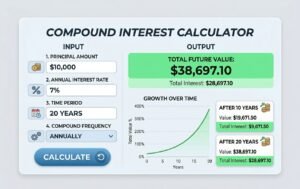
Compound interest is often called the most powerful force in personal finance, and for genuinely good mathematical reasons — money doesn’t just earn interest, it earns interest on its own previously earned interest, and the more frequently that happens, the faster the overall growth accelerates. The Compound Interest Calculator on AliGreat.com lets you see this effect clearly and precisely, across every common compounding frequency used by Indian banks and financial products.
What does the Compound Interest Calculator do?
Enter your principal amount, the annual interest rate, the number of years, and how often the interest compounds — yearly, half-yearly, quarterly, monthly, or daily. The calculator instantly shows your final amount, the compound interest earned, and your original principal side by side, so you can see exactly how much of the final figure is genuinely new money generated purely by compounding.
The formula behind it
Compound interest follows the classic, universally used formula:
A = P (1 + r/n)ⁿᵗ
where P is the principal, r is the annual rate (as a decimal), n is the number of compounding periods per year, and t is the time in years. This exact same formula powers this calculator, the FD Calculator elsewhere on AliGreat.com, and virtually every compound-interest-based banking product — the only variable that meaningfully changes between different products is n, the compounding frequency they use.
A worked example
Suppose you invest ₹1,00,000 at 8% annual interest for 10 years, compounded quarterly.
A = 1,00,000 × (1 + 0.08/4)^(4×10) = 1,00,000 × (1.02)^40 ≈ ₹2,20,800
That’s roughly ₹1,20,800 in compound interest earned over the decade. Now compare the exact same principal, rate, and time period, but with yearly compounding instead of quarterly: A = 1,00,000 × (1.08)^10 ≈ ₹2,15,890 — about ₹4,900 less than the quarterly-compounded result, purely from the difference in how often interest is calculated and added back to the principal. Push the compounding frequency further to daily compounding, and the result climbs marginally higher still, to approximately ₹2,22,540 — illustrating that while more frequent compounding does meaningfully help, the marginal benefit of each additional step (yearly to quarterly to monthly to daily) shrinks progressively smaller each time.
Why compounding frequency changes the outcome
A rate of 8% compounded quarterly earns more than a flat 8% compounded yearly, even though the headline percentage rate is identical in both cases — because interest starts earning its own interest every three months instead of waiting a full year between compounding events. This is exactly why a bank FD advertised as “7% compounded quarterly” outperforms a hypothetical flat 7% simple-interest product over the same holding period, and it’s a genuinely important detail worth checking whenever two financial products quote the same headline rate but use different compounding terms in their fine print.
The Rule of 72 — a quick mental shortcut worth knowing
A handy back-of-envelope approximation for compound growth is the Rule of 72: divide 72 by your annual interest rate to roughly estimate how many years it takes for your money to double. At 8% annual compounding, that’s roughly 9 years; at 12%, roughly 6 years; at 6%, roughly 12 years. This calculator naturally gives you the exact, precise figure rather than this rough approximation, but the Rule of 72 remains a genuinely useful mental sanity check while comparing different rates quickly in your head, without needing to reach for a calculator at all.
Compounding over long periods — where the real magic happens
The gap between simple interest and compound interest is relatively modest over just a few years, but it becomes dramatic over two or three decades, because each year’s growth builds compoundingly on an ever-larger base than the year before. This is the core mathematical reason why starting to invest early — even with comparatively smaller monthly or lump-sum amounts — tends to significantly outperform starting later in life with larger amounts, purely due to the extra years available for compounding to do its accelerating work. A ₹1,00,000 investment left to compound at 10% for 30 years grows to roughly ₹17,45,000, while the same amount compounding for just 15 years reaches only about ₹4,18,000 — not half, but less than a quarter, of the 30-year figure, despite the time period only doubling.
Nominal rate vs effective annual rate
When comparing two products with different compounding frequencies, it’s often more useful to compare their effective annual rate (sometimes called APY, or Annual Percentage Yield) rather than their stated nominal rate. The effective annual rate accounts for the compounding frequency and represents the true, single equivalent yearly return you’re actually earning. For an 8% nominal rate compounded quarterly, the effective annual rate works out to approximately 8.24% — a small but real difference from the headline 8% figure, and one worth calculating whenever comparing products that quote different compounding conventions against each other.
Compound interest works both ways — for savings and for debt
The same formula that grows your savings also grows your debt if interest isn’t paid off regularly — credit card balances, for instance, compound in exactly this way on any unpaid amount, which is a major reason unpaid credit card debt escalates so rapidly compared to a simple-interest personal loan of a similar headline rate. Understanding this formula thoroughly is just as valuable for managing and avoiding excessive debt as it is for growing savings and investments, since the underlying mathematics driving both outcomes is identical.
Compound interest and taxation
It’s worth remembering that the compound interest figure this calculator produces is a pre-tax number. For instruments like FDs, the interest earned each year is generally taxable at your income slab rate (except for specific tax-exempt instruments like PPF), which means your actual post-tax compounding rate is somewhat lower than the gross rate you enter into this calculator — a detail worth factoring in separately when comparing the true, real-world growth of a taxable instrument against a genuinely tax-exempt one like PPF.
Comparing compounding frequency across real products
When shopping for a savings product, always check the compounding frequency stated in the terms, not just the headline annual rate. Recurring deposits and bank FDs in India most commonly compound quarterly by convention; some savings accounts compound quarterly as well; certain specific investment products may compound monthly or even daily. Running the same principal, rate, and time period through this calculator at each of the different compounding frequencies you’re comparing gives you a precise, apples-to-apples view of exactly how much difference the compounding convention alone makes to your final outcome.
Who should use this calculator
Anyone comparing FD, RD, or savings account interest offers that use different compounding frequencies, students or professionals wanting to genuinely understand how compounding works before applying it to real financial decisions, or simply anyone wanting to see precisely how a lump sum will grow over time under a specific set of assumptions will find this calculator directly useful.
Frequently asked questions
Does more frequent compounding always mean significantly more money? Yes, but the marginal benefit shrinks quickly — moving from yearly to quarterly compounding makes a meaningful difference, but moving from monthly to daily compounding typically makes only a very small additional difference on top of that.
What’s the difference between nominal rate and effective annual rate? The nominal rate is the stated annual percentage before considering compounding frequency; the effective annual rate accounts for compounding and represents the true single equivalent yearly return actually earned.
Is compound interest always better than simple interest for a saver? Yes, for identical principal, rate, and time period, compound interest always produces an equal or higher return than simple interest — they’re identical only for a period of exactly one year, and diverge more as the time period increases.
Does this calculator account for tax on the interest earned? No — it shows the gross, pre-tax compound interest figure. Your actual post-tax return will be lower for taxable instruments like regular FDs, depending on your applicable income tax slab.
Try it now
Open the Compound Interest Calculator on AliGreat.com and see exactly how your money grows under different compounding frequencies — free and instant.