Inflation Calculator — Calculate Future Cost & Purchasing Power | AliGreat.com
Free Inflation Calculator for India — see what today’s money will cost in the future, and what a future amount is worth in today’s rupees.
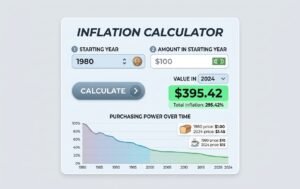
Inflation is often called the silent tax — it doesn’t show up on any bill or payslip, but it quietly erodes what your money can actually buy every single year, whether or not you notice it happening. The Inflation Calculator on AliGreat.com turns this abstract, easy-to-ignore idea into two concrete numbers: what something costs today will cost in the future, and what a future amount is really worth once translated back into today’s terms.
What does the Inflation Calculator do?
Enter a current amount, an assumed annual inflation rate, and a number of years. The calculator shows two related but distinct things: the projected future cost of that amount at the given inflation rate, and the equivalent purchasing power — what today’s rupee will actually be able to buy at that future date, expressed in today’s terms, given the eroding effect of inflation over that period.
The formula behind it
Two related formulas are at work here. Future cost uses standard compounding, exactly like compound interest but working in the opposite direction against your money’s value:
Future Cost = P × (1 + i)ⁿ
Purchasing power runs the same underlying idea in reverse:
Real Value = P / (1 + i)ⁿ
where i is the inflation rate and n is the number of years. Together, these two formulas answer both “what will this specific thing cost later?” and “what is a future amount of money actually worth right now, once inflation is stripped out?”
A worked example
Suppose a family’s monthly household expenses currently total ₹50,000, and you assume 6% average annual inflation over the next 15 years.
Future Cost = 50,000 × (1.06)^15 ≈ ₹1,19,830 per month
This means the exact same standard of living that costs ₹50,000 a month today will require roughly ₹1,19,830 a month in 15 years — not because your lifestyle has changed at all, but purely because prices for the same goods and services have risen. Now look at the reverse question: if you’re promised ₹1,00,000 as a lump sum 15 years from now, what is that actually worth in today’s terms at the same 6% inflation assumption?
Real Value = 1,00,000 / (1.06)^15 ≈ ₹41,730
In other words, a future ₹1,00,000 payout, 15 years from now, has the real purchasing power of only about ₹41,730 today — a genuinely sobering illustration of why nominal future amounts (salary figures, insurance payouts, fixed deposit maturity values) always need to be mentally adjusted for inflation before comparing them meaningfully against today’s costs or needs.
Why 6% is a commonly used assumption for India
India’s long-run consumer price inflation has hovered around 5-6% over extended historical periods, making 6% a commonly used, moderately conservative planning assumption for long-term financial calculations, while 4% aligns more closely with the Reserve Bank of India’s official inflation targeting band. The calculator lets you test both assumptions directly, since the gap between a 4% and 6% inflation assumption compounds into a meaningfully different picture over a 20-30 year retirement or long-term goal planning horizon — a difference that can easily run into lakhs or even crores of rupees on a large enough target corpus.
The “halving” effect of inflation — an intuitive way to think about it
At a 6% inflation rate, purchasing power roughly halves in about 12 years, following the same Rule of 72 logic used for compound growth (72 ÷ 6 ≈ 12). This means ₹1,00,000 today buys only roughly what ₹50,000 buys today, 12 years from now — even though the physical number of rupees you’re holding hasn’t changed at all in the interim. This single, relatable fact is often the most persuasive way to explain why simply holding savings in cash, or in a very low-interest account, quietly loses real ground every single year, even while the account statement shows the balance staying the same or slowly growing.
Why this calculator matters for every other financial plan on this site
Inflation isn’t really a standalone concept in isolation — it’s the essential backdrop every other financial calculation sits against, whether or not that calculation explicitly accounts for it. A retirement corpus target calculated purely in today’s rupee terms, without adjusting for inflation, will fall dramatically short of what’s actually needed once you’re 20-30 years further into the future and living at then-current prices. An investment that returns less than the prevailing inflation rate after tax is actually a slow loss in real, purchasing-power terms, even while the nominal account balance keeps climbing every year on paper. This calculator is often the natural first stop before using AliGreat.com’s Retirement Calculator, which explicitly builds an inflation assumption directly into its corpus and monthly-SIP projections.
Different inflation rates for different categories of spending
A single blended inflation figure (like the commonly used 6%) is a reasonable simplification for general planning purposes, but it’s worth knowing that inflation doesn’t hit every category of expense equally. Healthcare and education costs in India have historically risen considerably faster than the general Consumer Price Index — often in the 8-12% range annually for private healthcare and premium education specifically — while costs for some categories like electronics have actually fallen in real terms over time due to technological improvement. If you’re specifically planning for a healthcare-heavy retirement budget, or a child’s future higher education costs, running this calculator with a higher, category-specific inflation assumption (8-10% rather than the general 6%) will produce a more realistic and appropriately conservative future estimate.
A practical use: negotiating a salary or planning a big future expense
If you’re planning a large future expense — a child’s education, a wedding, a retirement home purchase — running today’s estimated cost through this calculator at a realistic inflation rate gives you a far more honest, defensible target than simply using today’s price tag as if it will remain unchanged. Many people significantly underestimate the true future cost of long-term goals precisely because they forget to inflate the current cost forward through the number of years remaining until the goal.
Inflation and salary negotiations
The same logic applies directly to salary planning: if your salary has grown by, say, 8% annually over the past several years while general inflation has run at 6%, your real income growth (the part that actually improves your standard of living, rather than just keeping pace with rising prices) has been closer to 2% annually — a meaningfully more modest figure than the headline 8% growth number suggests. This calculator can help frame salary negotiation targets in real, inflation-adjusted terms rather than purely nominal ones.
Who should use this calculator
Anyone setting a long-term savings goal, evaluating whether an investment’s return genuinely beats inflation after tax, planning for a future large expense like education or a wedding, or simply trying to understand how much less a fixed sum of money will realistically be worth in the future should use this calculator before finalising any long-term financial plan.
Frequently asked questions
What inflation rate should I use for general retirement planning in India? 6% is a commonly used, moderately conservative general planning assumption, though some planners use 7% for extra conservatism, particularly for expenses expected to include significant healthcare costs.
Why does the same amount of money seem to buy less every year even in a growing economy? This is the direct effect of inflation — as the general price level for goods and services rises, a fixed amount of money buys progressively less of them, even if your nominal income or savings balance is also rising.
Should I use a different inflation rate for healthcare or education planning? Yes — healthcare and education costs in India have historically risen faster than general inflation, so using a higher assumption (8-10%) for these specific categories tends to produce more realistic, appropriately conservative future cost estimates.
Does a bank FD or savings account beat inflation? It depends on the specific interest rate and prevailing inflation rate at the time — a savings account at 3-4% interest against 6% inflation represents a real, ongoing loss of purchasing power, even though the account balance itself is technically growing.
Try it now
Open the Inflation Calculator on AliGreat.com and see exactly how inflation will reshape your money’s future value — free and instant.