Prepayment Calculator — Loan Prepayment Savings Calculator | AliGreat.com
Free Prepayment Calculator for India — see exactly how much interest you’ll save by prepaying your loan, and whether cutting EMI or tenure saves more.
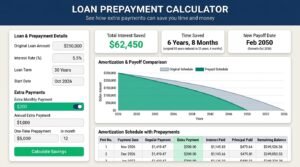
Most floating-rate loans in India allow part-prepayment without penalty, but the actual decision of how to apply that prepayment — reduce your EMI or reduce your remaining tenure — isn’t obvious without running the actual numbers. The Prepayment Calculator on AliGreat.com compares both options directly against each other and against doing nothing, so you can see exactly which choice saves more before you make the payment.
What does the Prepayment Calculator do?
Enter your original loan amount, interest rate, original tenure, how many EMIs you’ve already paid, and the lump-sum amount you plan to prepay. Choose whether you’d rather keep your EMI the same and shorten the remaining tenure, or keep the tenure the same and reduce your EMI instead. The calculator shows your new EMI, the remaining tenure after prepayment, the outstanding balance immediately before the prepayment was applied, and — most importantly — the total interest saved compared to not prepaying at all.
The logic behind it
The calculator first works out your outstanding principal at the point of prepayment, using the loan’s underlying amortization schedule based on your original terms and how many EMIs you’ve already paid. It then subtracts your prepayment amount from that outstanding balance. From there, two distinct paths are possible: if you choose to cut tenure, the calculator solves for the new, shorter number of months required to fully repay the reduced balance while keeping your original EMI unchanged; if you choose to cut EMI instead, it recalculates a lower EMI spread over your original remaining tenure. Both resulting paths are then compared against the interest you would have paid had you not prepaid at all, to arrive at the total interest saved figure.
A worked example
Suppose you took a home loan of ₹40,00,000 at 8.5% for 20 years, have already paid 24 EMIs (2 years in), and now want to prepay ₹2,00,000 as a lump sum.
- Original EMI ≈ ₹34,713
- Outstanding balance after 24 EMIs ≈ ₹38,26,000
- Balance after applying the ₹2,00,000 prepayment ≈ ₹36,26,000
If you choose to keep the EMI unchanged and reduce tenure: the remaining tenure shortens from 216 months to approximately 198 months — saving roughly 18 months, and total interest saved comes to approximately ₹9,80,000 over the life of the loan.
If you choose to keep the tenure unchanged and reduce the EMI instead: the new EMI drops to roughly ₹32,930 (saving about ₹1,783 per month in cash flow), but total interest saved comes to only approximately ₹3,85,000 — considerably less than the tenure-reduction option, because you continue paying interest for the full original remaining 192 months rather than finishing sooner.
This gap — nearly ₹6,00,000 more in savings from choosing tenure reduction over EMI reduction, on the exact same ₹2,00,000 prepayment — is the single most important insight this calculator surfaces, and it holds true directionally across almost every prepayment scenario, though the exact magnitude varies with the loan’s specific rate, remaining tenure, and prepayment size.
Why reducing tenure usually saves more than reducing EMI
When you keep the EMI the same and shorten the tenure, every rupee of that unchanged EMI keeps attacking the principal balance at exactly the same aggressive pace it always has — you simply finish paying off the loan sooner, cutting off a chunk of interest that would otherwise have accrued during those final months. When you instead reduce the EMI and keep the original tenure unchanged, you get welcome monthly cash-flow relief starting immediately, but you continue paying interest for the entire original remaining period, just at a slightly lower monthly rate. In almost every case, choosing to cut tenure rather than cut EMI results in significantly higher total interest savings — though reducing EMI remains the objectively right choice if immediate monthly cash-flow relief, rather than long-term total interest minimisation, is your actual and more pressing constraint.
Why prepaying early in the loan matters so much
Because interest in any amortising loan is calculated on the outstanding balance — which is highest in the early years and falls gradually over time — a prepayment made in year 2 or 3 of a 20-year loan saves considerably more total interest than the identical rupee amount prepaid in year 15, when the outstanding balance (and therefore the interest being charged on it each month) is already much lower. This is one of the most consistently underused financial moves available to Indian borrowers, largely because the benefit isn’t obvious without running the actual numbers through a calculator like this one.
Prepayment as a risk-free “investment” — and when it beats investing instead
Prepaying a loan effectively earns you a guaranteed return equal to your loan’s interest rate, with zero market risk — a genuinely rare comparison point against volatile investment alternatives. For a loan at 8.5%, prepaying is mathematically equivalent to earning a guaranteed, tax-free 8.5% return on that money, which is higher than many fixed-income alternatives like FDs (especially after accounting for FD interest being taxable) and carries none of the uncertainty of equity market returns. This is why financial advisors often suggest that, for borrowers with a home loan interest rate above roughly 8-9%, prepaying can be a more attractive use of surplus funds than investing in a low-risk instrument, though for lower-rate home loans (especially with the tax deduction benefit under the old regime factored in), continuing to invest a lump sum in equity markets instead may produce a higher expected return over the long term — the right choice genuinely depends on your specific loan rate, tax regime, and risk tolerance.
Prepayment charges — what to check before prepaying
Under RBI guidelines, banks and NBFCs cannot charge a prepayment penalty on floating-rate home loans taken by individual borrowers, making prepayment essentially free of charge for the vast majority of home loan borrowers in India. However, fixed-rate loans, and non-home-loan products like personal loans and car loans, may still carry a prepayment or foreclosure charge, typically ranging from 2-5% of the prepaid or outstanding amount — always check your specific loan’s terms and conditions before assuming prepayment is free, since this varies meaningfully by loan type and lender.
Partial prepayment vs full foreclosure
This calculator models a partial prepayment scenario, where you pay down a portion of the outstanding balance and continue the loan under revised terms. A full foreclosure — paying off the entire remaining balance at once — is a related but distinct decision, generally sensible once you have sufficient surplus funds and the interest saved on the remaining balance clearly outweighs any better use for that lump sum elsewhere, such as building an emergency fund or investing for a longer-term goal with a potentially higher expected return.
Who should use this calculator
Anyone who has received a bonus, a matured investment, an inheritance, or any spare lump sum, and is deciding whether to prepay an existing loan — and if so, whether to shorten the tenure or reduce the EMI — should run their exact numbers through this calculator before deciding. It’s equally useful for borrowers simply curious about how much interest a smaller, more routine annual prepayment (say, from an annual bonus) could save over the life of a long-tenure loan, even without a single large windfall to apply.
Frequently asked questions
Is it always better to reduce tenure rather than EMI when prepaying? In terms of total interest saved, yes, in the vast majority of cases — but if your priority is immediate monthly cash-flow relief rather than long-term interest minimisation, reducing EMI is the more appropriate choice for your situation.
Are there charges for prepaying a home loan in India? For floating-rate home loans taken by individuals, RBI guidelines prohibit prepayment penalties, making it effectively free. Fixed-rate loans and other loan types may still carry a prepayment charge — always check your specific loan agreement.
Does prepaying early in the loan always save more than prepaying later? Generally yes, since interest is calculated on the outstanding balance, which is higher earlier in the loan — the same prepayment amount saves progressively less interest the later it’s made in the loan’s life.
Should I prepay my loan or invest the money instead? This depends on your loan’s interest rate compared to your realistic expected investment return, your tax regime (given available home loan deductions under the old regime), and your personal risk tolerance — there’s no universally correct answer, but prepaying is the effectively guaranteed, risk-free option.
Try it now
Open the Prepayment Calculator on AliGreat.com, enter your loan and prepayment details, and see exactly how much interest you stand to save — free and instant.