RD Calculator — Calculate Recurring Deposit Maturity Amount Online | AliGreat.com
Free RD Calculator for India — find your recurring deposit maturity value and interest earned using the exact quarterly-compounding formula Indian banks use.
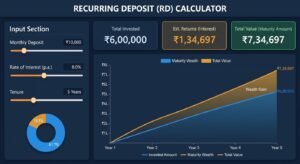
A Recurring Deposit is the bank-account cousin of a SIP — instead of investing in the market every month, you deposit a fixed amount into a bank RD and earn a guaranteed, pre-decided interest rate on it. It’s a popular choice among people saving toward a known, near-term goal where market risk simply isn’t welcome. The tricky part is that RD interest isn’t calculated the same simple way as an FD’s — Indian banks use a specific quarterly-compounding formula built around monthly deposits — which is exactly what the RD Calculator on AliGreat.com handles for you automatically.
What does the RD Calculator do?
Enter your monthly deposit amount, the interest rate your bank offers, and the tenure in months, and the calculator instantly shows your maturity amount, the total amount you’ll have deposited over the tenure, and the interest earned on top of it. Everything is calculated in your browser the moment you move a slider — no waiting, no sign-up, no spreadsheet required.
The formula behind it
Recurring deposits in India follow a specific formula built around quarterly compounding, even though deposits are made monthly:
M = R × [(1 + i)ⁿ − 1] / [1 − (1 + i)^(−1/3)]
where R is your monthly deposit, i = r/400 (the quarterly rate derived from your annual rate r), and n is the number of months. This looks more complex than a simple interest calculation because each monthly deposit sits in the account for a different length of time before maturity, and the bank compounds the entire accumulated pool quarterly rather than monthly — the AliGreat.com calculator applies this exact bank-standard formula rather than a rough approximation that many simpler online tools use.
A worked example
Suppose you deposit ₹5,000 every month into an RD at 7% annual interest for 5 years (60 months).
- Total deposited = ₹5,000 × 60 = ₹3,00,000
- Applying the formula with i = 7/400 = 0.0175 and n = 60 gives a maturity value of roughly ₹3,58,000
That works out to approximately ₹58,000 in interest earned over the 5-year period — a meaningful addition purely from committing a fixed monthly amount and letting the bank’s compounding do the rest.
Why RD interest calculations look different from FD calculations
An FD is a single lump sum compounding for a fixed, known period — every rupee experiences the exact same tenure. An RD, by contrast, is a series of deposits, each one sitting in the account for a different length of time: your first month’s deposit compounds for the full tenure, while your final month’s deposit barely has time to earn any interest at all before maturity. The quarterly-compounding RD formula accounts for this staggered effect across every single instalment, which is why it looks more complex than the straightforward FD formula despite both ultimately being built on compound interest.
RD vs SIP vs FD — where each one fits
An RD guarantees your rate and your maturity amount from the day you open it — there’s no market movement to worry about, unlike a SIP invested in mutual funds, where returns fluctuate with market performance. Compared to a lump-sum FD, an RD suits situations where you don’t have the full amount available today but can commit to a fixed monthly outflow instead — think of it as “FD for people paying in instalments.” It’s a natural fit for goals like an upcoming wedding, a vehicle down payment, or building an emergency fund over a 1–5 year horizon, where the certainty of a guaranteed, pre-known return matters more than chasing a potentially higher but uncertain market-linked return.
The trade-off is return potential: because RDs (like FDs) are guaranteed, low-risk products, their returns are structurally lower than what equity-oriented SIPs have historically delivered over long periods. An RD is the right tool when your time horizon is short and certainty matters; a SIP into equity mutual funds is generally the better tool when your time horizon is long (7+ years) and you can tolerate short-term volatility for potentially higher long-term growth.
Tax treatment of RD interest
RD interest is fully taxable as per your income tax slab, exactly like FD interest — there is no special tax treatment or exemption specific to recurring deposits. Banks deduct TDS if the total interest earned across your deposits with that bank crosses the applicable threshold in a financial year (the same ₹40,000 / ₹50,000 for senior citizens threshold that applies to FDs). As with FDs, you can submit Form 15G or 15H to avoid TDS deduction if your total income falls below the taxable limit — but the underlying tax liability on the interest itself remains unchanged regardless of whether TDS was deducted.
Choosing the right RD tenure
Most Indian banks offer RD tenures ranging from as short as 6 months up to 10 years, in various fixed intervals. Shorter tenures (6 months to 2 years) suit near-term goals and typically carry slightly lower interest rates than longer tenures. Medium tenures (3–5 years) often carry the most attractive rates while still being relatively liquid if plans change. It’s worth checking a bank’s specific RD rate card, since rates don’t always increase monotonically with tenure — some banks offer their best rates on a specific “sweet spot” tenure like 15 or 18 months as a promotional offer.
Premature withdrawal and missed instalments
Most banks allow premature closure of an RD, typically at a reduced interest rate similar to FD premature withdrawal penalties. Missing a monthly instalment usually attracts a small penalty fee per missed payment, and if too many instalments are missed, some banks may close the RD automatically — so an RD requires a genuine ongoing commitment, unlike a SIP where a missed month simply results in a smaller final corpus rather than account-level penalties.
Why RD rates don’t move once you’ve started
Similar to an FD, the interest rate on your RD is typically locked in for the entire tenure from the day you open the account, even if the bank’s RD rates for new customers change afterward. This means an RD opened during a high-rate period continues earning that original rate throughout, which can work in your favour if rates fall, or work against you if rates rise significantly after you’ve locked in.
Who should use this calculator
The RD Calculator is ideal if you’re deciding how much to set aside every month for a specific goal, comparing RD offers across two or three banks before committing, or simply want to see how a consistent habit of monthly saving adds up over a few years with guaranteed, predictable interest. It’s also useful as a comparison point against a debt-fund SIP for the same monthly amount and tenure, to weigh guaranteed returns against potentially higher but variable ones.
Frequently asked questions
Why is the RD formula different from a simple SIP calculation? RD interest is compounded quarterly by Indian banking convention, using a specific formula, while a SIP calculation compounds monthly based on the market-linked return you assume — the two use related but distinct mathematical approaches.
Can I withdraw my RD before maturity? Yes, most banks allow premature closure, though usually at a reduced interest rate compared to the full-tenure rate, and sometimes with a small penalty.
What happens if I miss a monthly RD instalment? Most banks charge a small penalty per missed instalment, and repeated missed payments can lead to the RD being closed automatically — check your specific bank’s terms.
Is RD interest taxed differently from FD interest? No — both are taxed identically, added to your total income and taxed at your applicable income tax slab rate for the financial year.
Try it now
Open the RD Calculator on AliGreat.com, enter your monthly deposit, rate and tenure, and see your exact maturity value instantly — calculated with the same formula banks use, shown transparently so you know exactly where the number comes from.